Asphalt driveway paving in Scranton
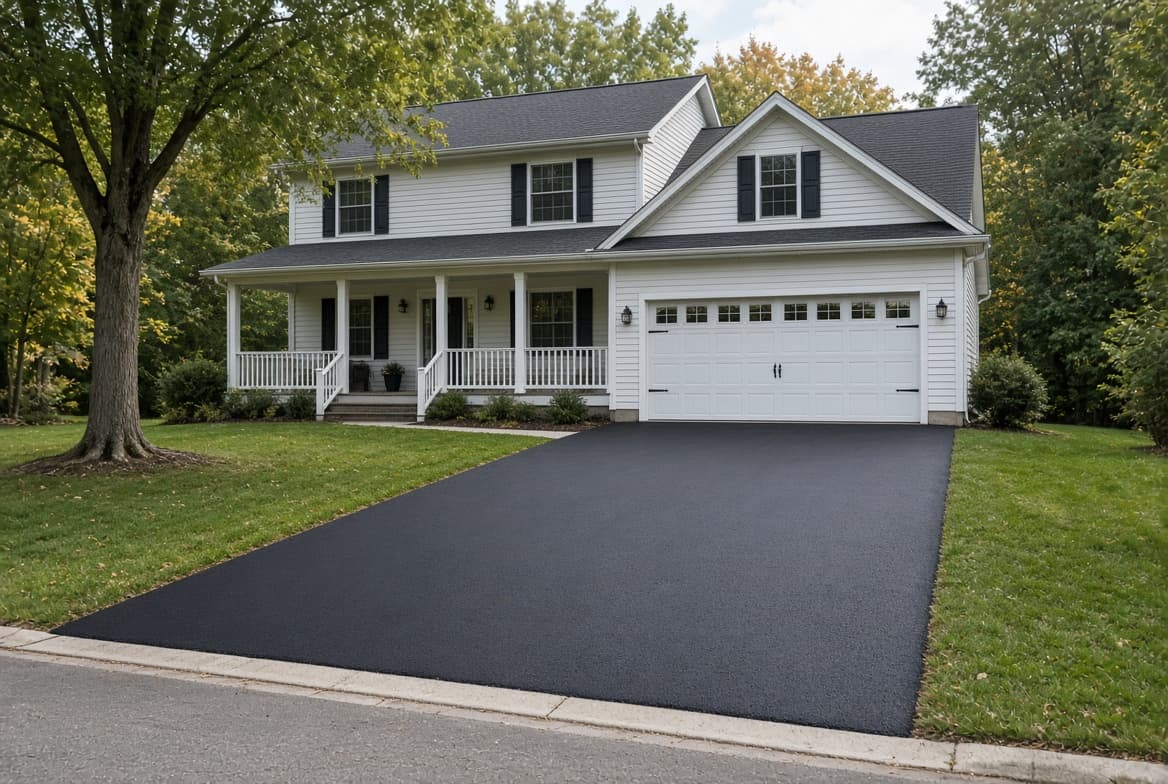
New driveways, full tear-out and replacement, and gravel-to-asphalt conversions — built on a real stone base, with the thickness written on the quote.
A new asphalt driveway is one of the few home projects you’ll only buy two or three times in your life, and nearly all of what makes it last is buried where you’ll never see it again. This page covers what a driveway costs in Scranton, what a proper one is made of, and how to make sure that’s what you’re paying for.
Which driveway job do you need?
New driveway
Ground that’s never been paved — a new build, an addition, or a widened parking pad. The work is excavation, grading so water runs away from the house, a compacted stone base, and then asphalt.
Tear-out and replacement
The old asphalt is broken up and hauled away, the base is repaired or rebuilt, and new asphalt goes down. This is the right answer when the base has failed: alligator cracking (a web of connected cracks), potholes that come back in the same place, or soft spots that flex underfoot. If your driveway is just faded or rough on top, you may not need this: ask whether a sealcoat or an overlay would do before paying for a tear-out.
Gravel-to-asphalt conversion
A common upgrade on longer and rural driveways. Existing gravel usually can’t just be paved over — it’s typically mixed with dirt and uneven after years of plowing. It gets regraded, topped up with clean stone, and compacted into a proper base first. The existing stone often lowers the base cost compared with building from bare ground.
What a driveway costs in Scranton
Based on published 2025–26 pricing for Pennsylvania, here’s where most residential driveways land. For a range on your own size and site, use the driveway cost estimator.
| Job | Per sq ft | Single-car (400 sq ft) | Two-car (800 sq ft) |
|---|---|---|---|
| New, over existing gravel | $5–8 | $2,000–3,200 | $4,000–6,400 |
| New, from bare ground | $6–11 | $2,400–4,400 | $4,800–8,800 |
| Tear-out & replace | $6–11 | $2,500–4,400 | $4,800–8,800 |
The biggest swings come from how much base work the site needs, the slope (a noticeable hill adds roughly 10%, a steep one up to 25%), and whether trucks or an RV will park on it, which calls for a thicker build. Small driveways cost more per square foot because the paver, roller and crew cost the same to bring out regardless of size.
The spec: what a Scranton driveway should be made of
Northeastern Pennsylvania is hard on asphalt. Water gets into cracks, freezes, and expands — dozens of times a winter. Plows scrape the surface and road salt sits in every crack. Much of the valley sits on heavy clay that holds water, so a thin base moves no matter how nice the surface looks. A driveway built for this climate needs:
- 6–8 inches of compacted stone base for cars, more for trucks and equipment. This is what carries the load and lets water drain.
- 2.5–3 inches of compacted asphalt, laid as a binder course with a smoother wearing course on top. “Compacted” matters — 3 inches loose rolls down to about 2.25.
- Proper compaction with a roller, while the mix is still hot.
- Pitch for drainage, so water runs off the surface and away from the house, not into the base.
- A clean tie-in at the street and supported edges. Crumbling edges and a broken apron are where most driveways start to fail.
If a quote just says “asphalt driveway” and a price, ask for the compacted asphalt thickness and the stone base depth in writing. The cheapest quote is usually cheap because it’s thinner.
How a driveway job goes
- Site visit and written quote. The contractor checks the base, drainage, slope, and the street connection, then puts the spec and price in writing.
- Tear-out and grading (for replacements and new builds). Old asphalt is removed and the ground is shaped so water drains away.
- Base. Stone is spread and compacted in layers. Soft or wet spots found here are dealt with — and a good contractor tells you before extra work is added.
- Paving. Hot mix is laid and rolled while it’s hot. Most residential driveways are paved in a single day.
- Curing. Stay off it for a few days. Avoid sharp turns, kickstands, and jack stands through the first summer, and don’t sealcoat it for at least 90 days.
When to pave
Hot mix has to be laid and compacted while it’s hot, so paving here runs roughly April through October, when the asphalt plants are open and air temperatures stay comfortably above 50°F. Spring calendars fill quickly after a hard winter; getting a quote in the fall or late winter is the easiest way to get on the schedule early.
If a crew shows up offering a cheap driveway with material from a job down the road, cash today, walk away.
Common questions
How much does a new asphalt driveway cost in Scranton?
Most two-car driveways (around 800 sq ft) run about $4,000–6,400 over existing gravel and $4,800–8,800 for a tear-out and replacement, based on published 2025–26 Pennsylvania pricing. Slope, base work, and thickness move the number. Try the cost estimator for your driveway.
How long does an asphalt driveway last in Pennsylvania?
A driveway built on a proper compacted base, with good drainage and regular maintenance (crack filling, and sealcoating every 2–3 years), commonly lasts 15–20 years or more. Thin driveways on poor bases can fail in a few winters.
Can you pave over an old asphalt driveway?
Sometimes. If the base is sound and the surface is just worn, a 1.5–2″ overlay is cheaper than replacement. If there’s alligator cracking or recurring potholes, the base has failed and an overlay will crack through.
How long before I can drive on a new driveway?
Usually a few days, depending on the heat. Fresh asphalt stays soft through its first summer, so avoid sharp turns, kickstands, and jack stands, and don’t park in exactly the same spot every day.
Do I need a permit for a driveway in Scranton?
It depends on the municipality and the work — changes at the street, a new curb cut, or drainage changes are the usual triggers. The contractor should know the local requirements and tell you on the quote; ask your borough or township if you’re unsure.
Get a driveway quote with the spec written down.
Free, no obligation, and no door-knocking. See your price range first, then a local paving contractor follows up.